If you’ve ever walked through a plastic packaging factory, a disposable tableware workshop, or even a medical parts manufacturing plant, you’ve likely seen a four station thermoforming machine at work. These rugged, versatile pieces of equipment handle everything from blister packs for medication to clamshells for takeout containers, and their reliability can make or break a production line. As a supplier of these machines, one of the most common questions I get from new and returning customers alike isn’t about speed or size—it’s about the warranty period. Let’s cut through the noise, talk about what a warranty actually covers (and what it doesn’t), and why this detail matters more than you might think. Four Station Thermoforming Machine
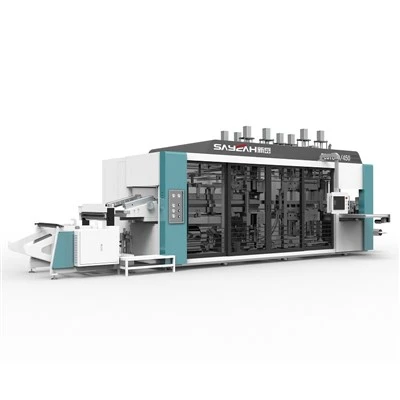
First, let’s ground this in what a four station thermoforming machine does. Unlike single-station units that run one process at a time, four station machines cycle through four distinct steps: loading the plastic sheet, heating it to a pliable temperature, forming it into the desired shape using a mold, then trimming and ejecting the finished part. All of this happens in a continuous, synchronized cycle, which makes them far more efficient for mid-to-high volume production than their single-station counterparts. That complexity is why their warranty isn’t a one-size-fits-all number—it depends on several factors, and I’ve seen far too many customers make assumptions that come back to bite them down the line.
When a customer first reaches out to me asking, “How long is the warranty on your four station machines?” I don’t just give them a number right away. I start by explaining that our standard warranty is 12 months or 2,000 operating hours, whichever comes first. But here’s the thing: that’s the base for most new, properly operating machines, but it can shift depending on how the machine is used, what components it’s built with, and the level of support we agree to as part of the purchase. Let’s break that down, because there’s a huge difference between the warranty we offer as a reputable supplier and what you might get from a no-name import.
First, let’s talk about the difference between operating hours and calendar time. A lot of customers assume 12 months, but if you run a two-shift, six-day-a-week operation, you might hit 2,000 hours in 8 months—so the warranty expires sooner. For customers who run lighter, one-shift operations, it might stretch to 18 months. That’s why we always clarify this at the time of sale, instead of waiting for a problem to arise. I had a customer last year who bought a basic four station machine for a small specialty packaging shop. They only ran it 4 hours a day, five days a week, so their warranty lasted almost 20 months. Another customer, a large food packaging manufacturer, ran theirs 24/7, and their warranty was gone in 7 months. Both were happy, because we spelled that out upfront.
Now, what does that standard 12-month/2,000-hour warranty actually cover? This is where a lot of confusion happens. Too many manufacturers will advertise a “1-year warranty” that only covers a broken bolt or a loose wire, but leave all the expensive parts out. Our warranty covers defects in materials and workmanship for all core components: the heating elements, the forming and trimming stations, the servo motors that control the synchronized cycles, the PLC (programmable logic controller) that runs the machine, and the frame and structural components. That means if a heating element fails prematurely because of a manufacturing defect, or a servo motor stops working within the warranty period, we ship a replacement part for free, and we cover the cost of our technician to come on site to install it, or we provide full remote support for customers who have in-house maintenance teams.
But there are big caveats here, and I make sure every customer understands them before they sign a purchase order. The warranty does not cover wear and tear from regular operation. That might sound counterintuitive, but a thermoforming machine’s cutting blades, for example, are designed to dull over time as they cut through thousands of plastic sheets. We don’t replace dull blades for free, because that’s normal usage—just like you don’t get a new set of tires for a car that’s driven 10,000 miles. Similarly, we don’t cover damage from improper setup, using the wrong type of plastic sheet (like a thicker material the machine wasn’t designed to handle), or routine maintenance that wasn’t performed as outlined in the operation manual. We’ve had customers who skipped scheduled cleaning of the heating station, which caused a fire that damaged the PLC—we weren’t able to cover that, because it was due to lack of proper care.
That said, we do offer extended warranty options, and they’re some of the most valuable add-ons we sell, especially for customers who rely on their four station machines 24/7. For an extra cost, customers can extend the warranty to 24 months or 4,000 operating hours. This extended warranty covers the same core components, plus it includes coverage for wear items that are normally excluded in the standard warranty: cutting blades, vacuum pumps, and gearboxes. We also offer a maintenance package as part of the extended warranty, where a technician comes on site every 6 months to inspect the machine, replace worn parts before they fail, and calibrate the forming and trimming stations to keep production running smoothly. I always tell customers that this isn’t just a money grab—it saves them thousands in unexpected downtime, because a single day of a production line being down can cost more than the extended warranty itself.
Why does this matter so much for four station machines specifically? Let’s compare them to another common type: rotary thermoforming machines. Rotary machines have a slightly different warranty structure, because their cycle is different, but four station machines have more moving parts in the synchronized stations, and they’re often used for more delicate applications, like forming thin plastic for medical devices or food packaging. A defect in the forming station of a four station machine can ruin entire batches of product, leading to costly rework and lost revenue. A good warranty means you’re not on the hook for those unexpected costs when a defect is our responsibility.
I also want to address a common misconception I hear all the time: “All four station thermoforming machine warranties are the same.” That’s just not true. As a supplier, I’ve seen machines from overseas manufacturers that advertise a 1-year warranty, but only cover defects for the first 1,000 hours, not 2,000. Or they require the customer to ship the broken part back to their factory in Asia at their own cost, which can be hundreds of dollars for a large motor or PLC. Our warranty includes free shipping for replacement parts anywhere in North America (and we offer discounted shipping for international customers), and we have a network of local technicians across the U.S. and Canada who can be on site within 48 hours of a reported problem, not weeks. That’s a huge difference when your production line is idle and orders are on hold.
Another point to consider is the warranty for custom modifications. Many customers buy four station machines and modify them to run specific types of plastic, or add extra stations for specialized parts. As long as those modifications are done by our team or approved by our engineering department, the warranty still applies. If a customer tries to modify the machine on their own, that voids the warranty immediately, which is why we always encourage customers to come to us first with any custom needs. We design our machines to be flexible, so we can work with you to adjust the forming stations, heating settings, and trimming tools for your specific product, without risking your warranty.
Let me share a recent example that illustrates why all this is important. A customer in the Midwest bought a four station machine from a supplier that advertised a 1-year warranty. Six months later, their PLC failed. The supplier said the warranty only covered defects in parts, but claimed the customer had used the wrong grade of plastic, so they refused to cover it. The customer had to pay $8,000 for a new PLC and $2,000 for installation, and their production line was down for three days. When they came to us for a replacement machine, we walked them through the warranty process upfront, showed them exactly what was covered, and explained how we test every PLC before shipping to prevent that type of failure. They ended up buying an extended warranty, and last month, a heating element failed at 1,800 hours—we shipped a replacement the next day, and our local technician installed it before their shift even started. No downtime, no extra cost.
So, to sum up the warranty period for a four station thermoforming machine: our standard warranty is 12 months or 2,000 operating hours, whichever comes first, covering defects in core components. Extended warranties are available up to 24 months or 4,000 hours, adding coverage for wear items and routine maintenance. Exclusions apply for normal wear and tear, improper use, or lack of scheduled maintenance, and all terms are clearly outlined in the purchase agreement so there’s no confusion.

If you’re in the market for a four station thermoforming machine, don’t just ask for a number—ask what that number actually covers. Ask about operating hour vs calendar time, replacement part shipping costs, local technician support, and what’s excluded. A warranty is only as good as how it works when you need it, not just what’s written on the spec sheet. If you have more questions about our four station machines, their warranty terms, or how to choose the right machine for your production needs, we’re here to help. Contact our team to discuss your requirements and get a customized solution for your business.
Plastic Cup Thermoforming Machine References:
- Plastics Technology. Thermoforming Equipment Warranty Best Practices. 2022.
- Society of Plastics Engineers. Four Station Thermoforming Machine Operation and Maintenance Guidelines. 2021.
- International Organization for Standardization. ISO 10843:2018, Plastics Machinery – Thermoforming Machines – Safety Requirements.
Zhejiang Sayeah Machinery Co., Ltd.
Zhejiang Sayeah Machinery Co., Ltd. is one of the most reliable manufacturers and suppliers of four station thermoforming machine in China, also supports high quality customized service. Please feel free to buy CE approved four station thermoforming machine from our factory. For price consultation, contact us.
Address: Wanquan District Industrial Zone,West Of China National Highway 104, Sunlou Village, Wanquan Town, Pingyang County, Zhejiang Province. China
E-mail: sales@sayeahmachinery.com
WebSite: https://www.sayeahthermoforming.com/
